
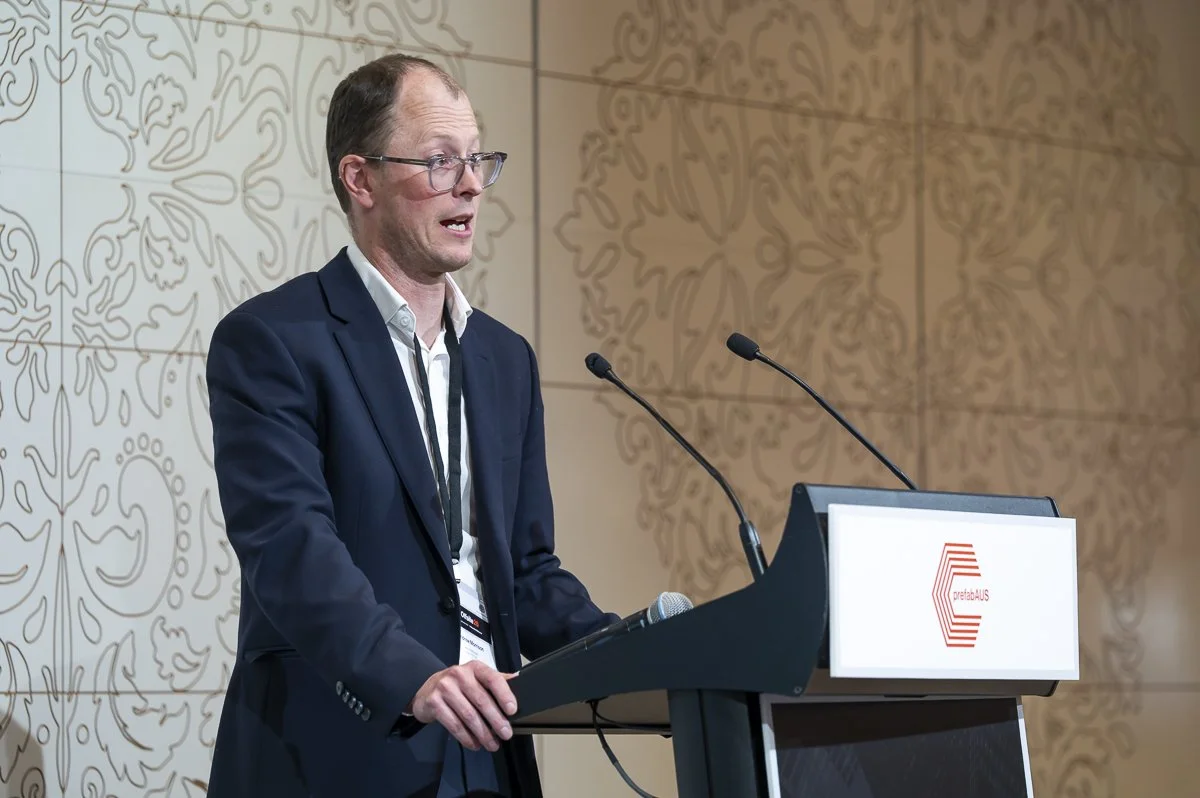
Kapitol Group's Andrew Morrison told Offsite26 that Australia doesn't have a modular construction problem; it has a certainty problem, drawing on a year of feasibility testing across $4 billion of potential projects to argue for accountable, contractor-led delivery.
Australia does not have a modular construction problem. It has a certainty problem. That was the argument Andrew Morrison, of Melbourne-based construction and engineering group Kapitol Group, put to delegates at Offsite26, drawing on 12 months of feasibility work across $4 billion in potential volumetric modular projects to make the case for a fundamentally different delivery model.
Morrison began by clarifying the title of his own talk, having already fielded some feedback on it. Tier one builders "owning" volumetric modular construction (VMC), he said, does not mean physically owning the manufacturing. Nor does it mean local manufacturers stop mattering. What he meant by ownership is accountability: one party holding the balance sheet, the project pipeline and the delivery capability needed to stand behind the outcome from design through to completion. "That's really the idea behind the title," he said, framing the rest of his talk as a sharing of lessons rather than a sales pitch.
A labour squeeze, not just a housing target
The pressure Morrison described is structural. Australia is well behind the National Housing Accord's target of 240,000 homes a year, construction costs are rising, and supply chains are under strain, particularly in Queensland. Meanwhile, major infrastructure projects are drawing trades away from residential work. Morrison pointed to Kapitol's M3 data centre project, where 800 electricians are on site at once, against a Victorian licensed electrician pool numbering only a few thousand. Lead hands on data centre projects can earn around $300,000 a year, he said, a figure residential work simply cannot match. With the Brisbane Olympics and an expanding defence pipeline set to pull further on the same trade base, he questioned how governments intend to deliver on their housing promises at all.
Part of the appeal Morrison described is price stability across jurisdictions. Feasibility work in Queensland, where supply chain pressure is currently most acute, showed construction costs running at nearly double those in Victoria, whereas the price of a volumetric module itself does not vary depending on which state it is destined for. He pointed to Singapore, where around 47 to 48 per cent of new homes are now built using MMC, as evidence that the approach is not new globally, only new to Australia at this scale.
Kapitol's own experience with modular construction at scale predates this residential push. Volumetric modules, including battery rooms, switch rooms and chillers, are now standard in the data centre sector, driven by labour constraints and program pressures rather than policy. The company's first fully modular data centre, built for NEXTDC in Darwin from 17 modules, shaved three months off the program. Morrison's pitch is that the same discipline now needs to be applied to housing, "the same problem, just at a much larger scale".
Rather than pitching modular on cost, Morrison reframed the conversation around certainty of program, certainty of revenue commencement and certainty of delivery, the language institutional capital actually uses. Kapitol's focus, he stressed, is not class one detached housing but higher-density asset classes: high-rise purpose-built student accommodation (PBSA), build-to-rent and hotels, where long-term owner-operators care as much about quality and revenue timing as they do about cost. Institutional capital, he noted, is currently showing a stronger appetite for this model than government.
Twelve months, $4 billion, and an honest set of findings
That appetite prompted Kapitol to run feasibility studies across roughly $4 billion of potential projects over the past year, a figure Morrison acknowledged was inflated by two large projects worth around $1 billion between them, but still substantial. The exercise involved trades, consultants, and building surveyors, and was tested to the point where Kapitol was prepared to sign contracts had clients chosen to proceed. Just as important, he said, was that the process proved modular is not the right answer for every project, a finding he considered as valuable as any positive result.
The pattern across the studies was consistent. Program savings sat at 20 to 35 per cent, once a single outlier project with heavy heritage constraints, which returned only 14 per cent, was excluded. Construction cost savings were far more modest, ranging from cost-neutral to around 10 per cent in highly optimised cases, a point Morrison used to push back on the assumption that faster automatically means cheaper. The more significant finding, in his view, was that modules typically represent around half of a project's overall capital cost. Once half the build moves off-site, modular construction stops being a subcontract package and becomes the project's core procurement strategy, reshaping decisions on cranes, logistics, shipping and site sequencing.
The Melbourne tower that proved the case, then stalled at board level
Kapitol's clearest proof point was a live, parallel tender for a 43-storey PBSA tower at A'Beckett Street in Melbourne. Kapitol ran a traditional construction proposal alongside a self-funded modular alternative developed with its own consultant team, delivering a full volumetric modular solution within eight weeks of a six-week tender period. The results, Morrison said, were striking: a seven-month program saving that would have moved practical completion from June, a poor point in the academic calendar for student accommodation, to November, capturing a full extra academic year of revenue. The modular scheme also delivered 10 per cent more beds by replacing conventional column-and-blade-wall structures with a more efficient modular frame, which allowed an extra single-occupancy unit per level, alongside a 10 per cent reduction in construction cost, verified against a traditionally priced comparison.
Despite an external project manager recommending the modular option, the project did not proceed at the board level. The combined novelty of a new delivery model, an unfamiliar funding profile and the fact that no 43-storey volumetric modular tower has yet been built in Australia proved too much to absorb at once. The exercise was not wasted, though. Kapitol has since entered early contractor involvement (ECI) arrangements with the same client, who Morrison said is now taking modular seriously as a feasible delivery pathway.
Knowing when to say no
Kapitol also uses the same feasibility discipline to turn work away. A viable modular project needs enough scale to "fill a ship", typically 100 to 150 modules, equivalent to roughly 50 apartments, depending on configuration. Below that threshold, the economics do not stack up. Morrison was equally candid about the trade-off at the heart of the method: locking in design early is both modular's biggest advantage and its biggest constraint. Construction managers tend to embrace it; development managers who need late-stage flexibility often do not. Kapitol has built prototype modules in Western Sydney, acting deliberately as what Morrison called "the dumb builder" on that project, simply installing units off the truck to learn the fixing details and transport logistics firsthand.
Why it isn't scaling yet
If the numbers work, Morrison asked, why isn't volumetric modular happening at volume? He identified three barriers. The first is assurance and compliance: building surveyors currently interpret performance-based solutions inconsistently, and Australia lacks an equivalent to the UK's BOPAS scheme, which he argued would give clients confidence without adding compliance burden. The second is a shallow skills base in design for manufacture and assembly (DfMA); Australia has designers and builders who understand modular construction well, but too few of them, and Morrison called for more knowledge sharing across the industry rather than firms guarding their expertise. The third, and in his view the most serious, is interface risk and fragmentation. Historic modular failures in Australia and overseas generally trace back to logistics, not manufacturing, and arise at four recurring interfaces: transport tolerances, weather protection, installation, and conditioning risk.
Morrison described two ways this risk is currently allocated, and rejected one of them outright. A fragmented model, in which a client selects a modular manufacturer and separately seeks a builder, leaves interface risk sitting with the client and effectively asks manufacturers to carry project risks they cannot control. He was careful to frame this as a criticism of the model, not of manufacturers themselves. The alternative, integrated contractor-led delivery, places a single head contractor across design, delivery, and warranty, with no gap for the client to fall through.
Sequencing offshore and local capacity
On the question of where modules should be made, Morrison argued for sequencing rather than substitution. Policy should enable offshore supply now, particularly at the government level, while local manufacturing capacity is built up; he was explicit that this is not an argument against local manufacturing, and that Australia needs substantially more local capacity than it currently has. His logic ran in a single line: accountability creates confidence, confidence creates pipeline, pipeline supports investment, and investment creates local capacity. Without proof at scale in Australia, he argued, that investment case does not yet exist, and projects like A'Beckett Street risk stacking up on paper without anyone willing to be first.
Morrison closed by reframing the industry debate itself. The question, he said, is no longer whether modular construction works. Kapitol's own numbers, drawn from a year of real feasibility testing rather than modelling, and its willingness to walk away from projects that do not stack up, have settled that question. The remaining question is who takes responsibility for making it work at scale, and that, in his view, means an accountable builder who brings pipeline, design, finance, logistics, and warranty together as a single delivery system.
For an industry still arguing over manufacturing capacity, procurement models and building surveyor interpretation, Morrison's message was pointed: the debate about method is largely over, and what is missing is a party willing to stand behind the outcome. Offshore capacity, in his framing, is not a threat to local manufacturing but the mechanism that proves the model can be trusted, so a proven pipeline can, in turn, support the local investment the sector says it wants. As Morrison put it to close his session, that is how modular moves from method to strategy.