
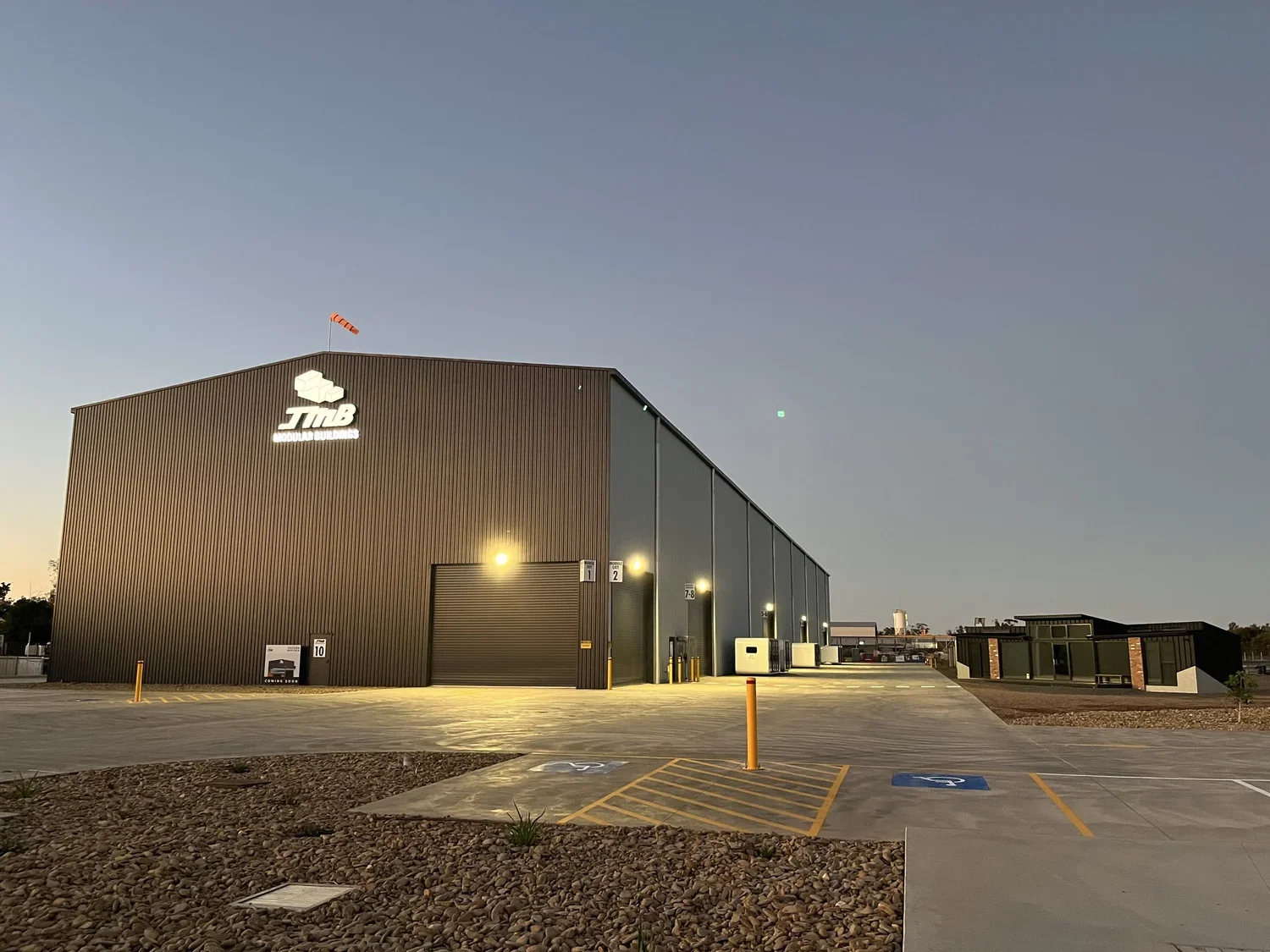
At JMB Modular's Advanced Manufacturing Centre in Shepparton, the capacity to build hundreds of modules a year already exists. JMB has been operating for more than a decade; AMC1 is the new facility built to scale up that experience. What's missing, say founders James and Rachel Briggs, isn't manufacturing capability, it's the finance, insurance and planning settings needed to put that capacity to work.
Ask James Briggs how many homes his factory could produce at full tilt, and the answer arrives without hesitation: 500 modules a year, once JMB Modular's five-stage master plan is complete and an afternoon shift is running. Today, Stage 1 of that five-stage plan is the only stage actually built and operating, and it delivers 100 modules a year at full capacity on its own, the current ceiling JMB is working within until further stages come online. In its first year of full operation, JMB expects to complete 72 modules: 21 commercial units destined for a four-level apartment development in Shepparton, which carry fire, acoustic, and sprinkler requirements that slow throughput, and 51 faster-moving residential modules behind them.
That's close to full utilisation of Stage 1. The Shepparton facility's cranes sit at 10.8 metres, enough to stack three storeys under cover; taller builds are assembled in the factory in stacks of three, then broken back down for transport, since JMB knows how the levels fit together internally before they ever reach public view on the road.
From construction company to advanced manufacturer
AMC1's significance isn't simply its production capacity. JMB has invested a significant amount in an advanced manufacturing environment built around volumetric construction: design, BIM/DfMA, engineering coordination, laser projection, light-gauge steel manufacturing, digital quality assurance, and module assembly on one controlled production line, moved by two 25-tonne overhead gantry cranes rather than trades shifting between sites. As James Briggs puts it: 'This isn't about putting houses in a shed. We are trying to turn construction into advanced manufacturing.
The manufacturing capability already exists. The ability to convert it into signed, buildable work doesn't come as easily.
The gap JMB describes isn't a shortage of interest. Demand has effectively doubled, and the business has knocked back projects it didn't have the capacity to run concurrently, and work with clients who came to modular for speed and scale rather than one-off builds. JMB's target market, deliberately, is buyers building in multiples of ten or more; repetition is what drives cost down and lets a crew move from first-of-type mistakes to a settled rhythm.
But converting demand into a signed, buildable job is harder than generating the demand itself. Two things sit behind that gap, in James and Rachel's account: funding, and what they call “security of pipeline”. Stage 4 of JMB's master plan, six adjoining warehouses that would move assembly work off the factory floor and free up throughput, is the stage that Regional Development Victoria has identified as offering the strongest return on investment. Whether it proceeds depends on securing a grant, a confirmed pipeline of work, or ideally both.
Insurance and regulation, not manufacturing, are the bottleneck
JMB is candid that the constraint isn't the factory floor. Homeowners' warranty insurance restricts the value of residential work a builder can have open at any one time, irrespective of available factory production capacity, and it doesn't release until handover, however long that handover takes. On one recent project, five completed homes sat finished in the factory while JMB negotiated with a water authority to upgrade ageing sewer infrastructure under a road; on another, a finished development sat under insurance for close to two years while neighbours disputed a retaining wall in court, entirely outside JMB's scope of works.
Commercial work carries no equivalent warranty scheme, so JMB uses commercial projects to keep factory throughput moving when residential capacity is capped, even though commercial modules are slower and more complex to build.
Planning conditions add a further layer of unpredictability to client projects. A $290,000 power upgrade was demanded mid-project on one current development, well after budgets and timelines had been locked in.
JMB has faced the same pattern in building its own factory. A disputed million dollar turning-lane requirement was raised for AMC1 after its own planning permit had already been endorsed, and fire authority requirements, individually reasonable, added up to a million litres of on-site water storage and a million dollars in sprinkler infrastructure. JMB accepts appropriate fire, planning, building and insurance requirements, but argues they need to be predictable, proportionate and known before investment and contracts are committed. Regulation built around conventional construction, its founders argue, doesn't always recognise the different risk profile of a home built in a secure, weatherproofed factory rather than assembled on an open site over the best part of a year.
Regional jobs and a new workforce model
AMC1 currently employs 23 people across trades, design, and administration; reaching full capacity at Stage 1 would require 68, a gap JMB plans to bridge with subcontractors rather than early over-hiring, having already been caught holding staff up due to red-tape delays on previous projects. The model's real value, Briggs argues, is in blending trades, BIM/design, manufacturing, engineering and logistics into a single regional workforce, rather than treating them as separate professions. Design work stays in-house, closing the loop between architect and factory floor, an arrangement James Briggs is protective of: architects see their drawings built the same week, rather than years later, if at all. Two of JMB's designers are recent architecture graduates who moved to Shepparton after migrating from India, drawn by hands-on factory experience that's rare in conventional practice.
What would actually help
Asked what the single most useful thing government or industry could do right now, James Briggs's answer is short: create bankable pipeline and invest in proven manufacturing capacity. That request comes after JMB has already invested millions into Stage 1 of AMC1 on its own account. But the fuller point sits just underneath that. What the business wants isn't sympathy; it's engagement from people who understand where projects actually stall, not just polished talking points from those a step removed from the factory floor and the sites it serves.
On financing, JMB points to the Commonwealth Bank's work on new MMC funding models, including its Prefab Home Loan and support for a prefab home contract now moving toward broader recognition, calling it a good start. JMB was also recently named the winner of the 2025 HIA Victoria Modular & Prefabricated Housing Award.
That, in the end, is the shape of JMB's case. The manufacturing side of the equation is solved: a working factory, a five-stage growth plan, and more demand than it can currently take on. What's left to solve sits in insurance caps, planning conditions and procurement settings built for a slower way of building homes. For an industry trying to demonstrate that Australian capacity is ready, JMB is a live example of what's already possible, and a reminder that closing the gap between that capacity and its full use is now a policy task, not a manufacturing one.
It would be good to mention that the Commonwealth Bank have been working through new MMC funding models with their Prefab Home Loan and assisted with a prefab home contract that will be recognised. It is a good start.
Can we also mention that we’d recently been recognised winner of the 2025 HIA Victoria Modular & Prefabricated Housing Award.
From construction company to advanced manufacturer
The significance of AMC1 is not simply its production capacity. JMB has invested approximately $9.8 million into creating an advanced manufacturing environment designed specifically around volumetric construction.
The facility brings design, BIM, engineering coordination, light-gauge steel manufacturing, digital set-out, quality assurance and module assembly into one controlled production system. Two 25-tonne overhead gantry cranes allow large modules to move through the factory rather than trades constantly moving between individual building sites.
JMB is also currently applying that system beyond detached housing. AMC1 is producing modules for a four-level apartment development in Shepparton, demonstrating the company's push into more complex multi-residential and commercial construction.
For James Briggs, that distinction is important. “This isn't about putting houses in a shed. We are trying to turn construction into advanced manufacturing.”
Pipeline is infrastructure too
For manufacturers, certainty of demand can be as important as financial assistance.
A factory cannot recruit and train dozens of people, install additional production equipment or commit millions of dollars to expansion on the assumption that individual projects may materialise. JMB argues that governments seeking greater MMC capacity should consider not only grants, but multi-year procurement pipelines that give proven manufacturers enough certainty to invest ahead of demand.
That does not mean guaranteeing work to individual companies. It means structuring housing and infrastructure programs so Australian manufacturers can see what is coming, qualify for it and confidently invest in the capability required to deliver it.
For JMB, the ambition extends beyond individual projects. It is about demonstrating that Australia can manufacture more of its buildings locally, create skilled regional jobs, improve construction productivity and build a sovereign MMC industry capable of making a meaningful contribution to the housing challenge
Asked what would make the greatest difference now, Briggs points to two things: bankable pipeline and support for manufacturers prepared to invest ahead of demand.
JMB is not arguing for regulation to disappear. It is arguing for regulation, insurance, finance and procurement systems to recognise that manufacturing buildings is fundamentally different from delivering them entirely through conventional site-based construction.
The distinction matters because the capital investment has already begun. AMC1 is operating today, people are employed, modules are moving through production and multi-level buildings are being manufactured in regional Victoria.
The next question for government and industry is therefore no longer whether Australia can develop an advanced modular manufacturing sector. Parts of that sector already exist.
The question is whether the systems surrounding it will allow that capability to scale.
“We aren't asking government to fund a PowerPoint presentation. We've already built the factory, invested the capital and started manufacturing. What we need now is a system that lets that capacity be used.”