
Steel-Framed and Scaling Fast
How SAW Constructions and Dynamic Steel Frame are Redefining Medium-Density Housing
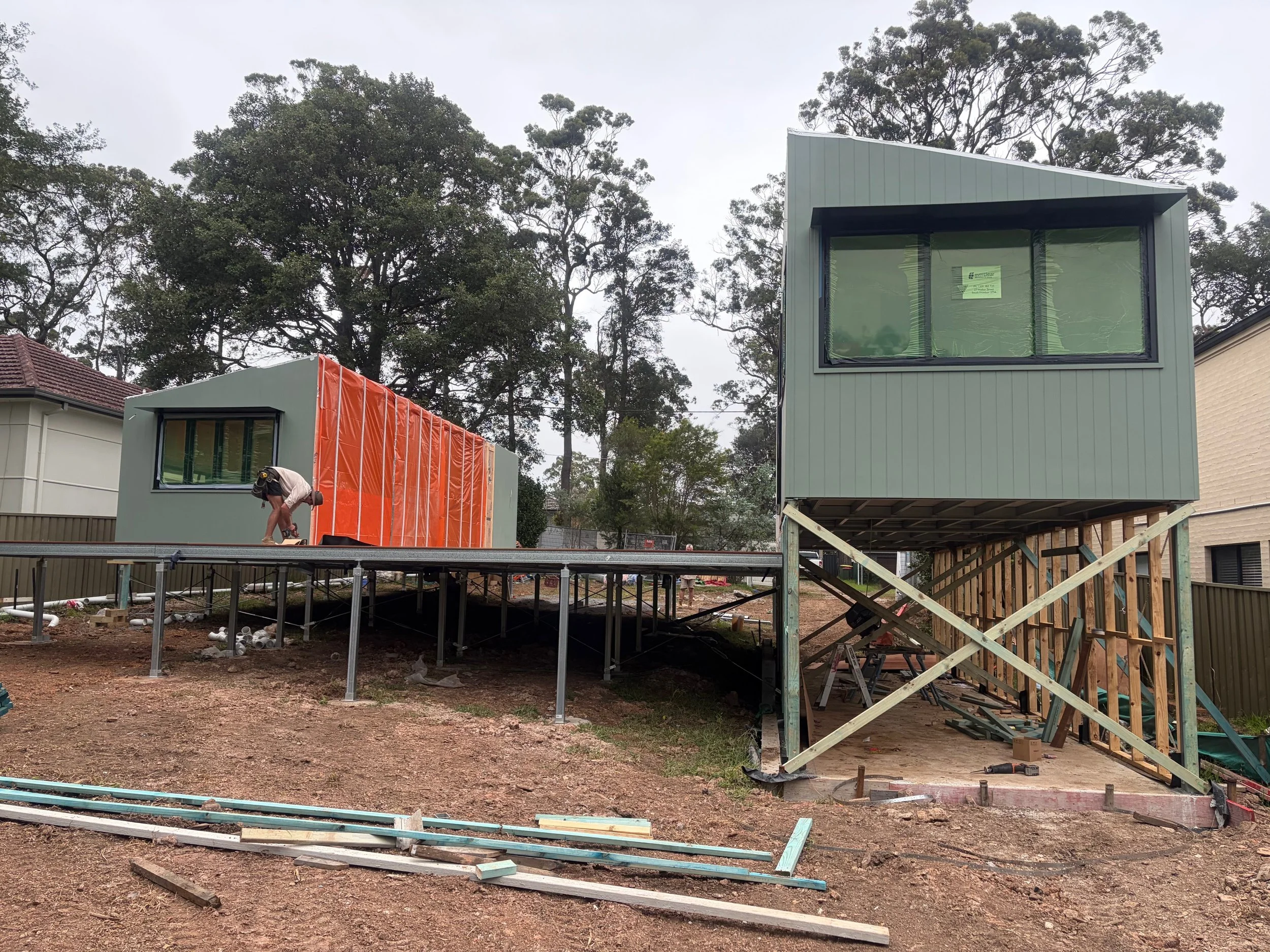
A builder who came in ‘kicking and screaming’ and a manufacturer with 13 years of pioneering experience have forged one of Victoria’s most productive partnerships in light gauge steel construction.
In an industry grappling with labour shortages, rising material costs, and the pressure to deliver 1.2 million new homes by 2030, the partnership between SAW Constructions and Dynamic Steel Frame stands as a compelling example of how collaboration and modern methods of construction can transform housing delivery at scale.
SAW Constructions is a Melbourne-based medium-density builder with two decades of experience specialising in two and three-storey townhouse developments. Dynamic Steel Frame, led by founder Peter Blythe, has spent 13 years pioneering light gauge steel (LGS) framing across residential, commercial, and modular construction — setting the benchmark in Victoria’s LGS sector.
From Reluctance to Revolution
The partnership’s origins are a story familiar across the prefabrication sector: initial resistance giving way to rapid conversion. SAW’s first encounter with Dynamic came through a 54-townhouse project in Brunswick, driven by a developer who insisted on steel framing. As Blythe recalls, every builder who tendered initially refused to use steel. SAW came in “kicking and screaming,” he says — but once the project was underway, the advantages became undeniable. SAW has essentially never gone back to timber.
Chris Stewart, who joined SAW’s leadership team in 2020 with prior LGS experience, accelerated the transition. “For me, it was a no-brainer. Let’s go all in on light gauge,” he says. Stewart acknowledges the challenges of integrating LGS into a traditional building business — trades accustomed to timber initially resisted, with mechanical, electrical, and plumbing contractors even charging surcharges for working with steel frames. Through close collaboration with Dynamic, service holes and penetration locations are now pre-determined and incorporated into each design, eliminating those surcharges and streamlining the build sequence.
Design-Led, Waste-Free Construction
At the heart of the partnership’s success is the design-led approach that LGS demands. Dynamic uses 3D modelling to resolve every detail with the builder before manufacturing begins — from structural loads and service penetrations to parapet heights and building levels. The result is accuracy to within half a millimetre.
“There is no waste on site. Nothing is cut on site. It all goes together like a Meccano set,” Stewart confirms. By contrast, traditional timber construction generates bins full of offcuts, and the inherent variability of timber — bowed studs, knots, inconsistent density — creates quality issues that compound through the build.
The weight advantages are equally significant. LGS framing weighs approximately one-third of an equivalent timber frame, dramatically reducing the structural steel needed for multi-storey construction. Blythe estimates that structural steel content on a typical townhouse project may be as little as 15-30% of what a timber-framed equivalent would require. Dynamic’s proprietary Hyperspan system — a deep-section purlin weighing around 12 kilograms per metre — can replace structural steel beams of 45 kilograms per metre, making installation faster and lighter.
Speed and Scale in Action
The partnership’s current flagship is the Maidstone project — 78 two and three-storey townhouses in Melbourne’s inner west, expected to be fully framed within approximately four months. SAW is Dynamic’s largest customer in the townhouse sector, with medium-density housing representing around 60–65% of Dynamic’s total pipeline.
The relationship has deepened to the point where SAW is planning to vertically integrate by rolling a portion of its own frames in-house. “Dynamic and Peter have given us the confidence to do that,” Stewart says.
A Broader Industry Shift
Both partners see LGS framing as central to addressing the structural challenges facing Australian construction. Stewart points to deteriorating timber quality and a shrinking trade labour pool as key drivers. “The industry is in a position where labour and resources are deteriorating, much like timber,” he says. “Having a fully resolved product is part of the solution.” SAW is actively training new framing crews, including converting timber framers and onboarding new entrants to the industry.
Blythe is equally confident about the sector’s trajectory. At three storeys, he notes, steel no longer needs to compete with timber on price — the structural requirements of multi-storey timber construction make it inherently more expensive. “At three storeys, we don’t even have to try to be more cost-effective — we just are.”
The sustainability case adds further weight. Steel framing is 100% recyclable at end of life, produces zero manufacturing waste, and generates significantly less freight emissions due to its lighter weight. When the full lifecycle is considered, Blythe argues steel is materially better than timber on environmental grounds.
The SAW Constructions and Dynamic Steel Frame partnership powerfully illustrates what the prefabAUS Industry Roadmap envisions: strategic collaboration between manufacturers and builders, driving productivity, quality, and scale through modern methods of construction. As Australia’s housing challenge intensifies, partnerships like this are not just promising — they are essential.