
Custom Home, Smarter Path
How One Family Built Their Dream Home with Prefab and Australia’s First Dedicated Construction Loan
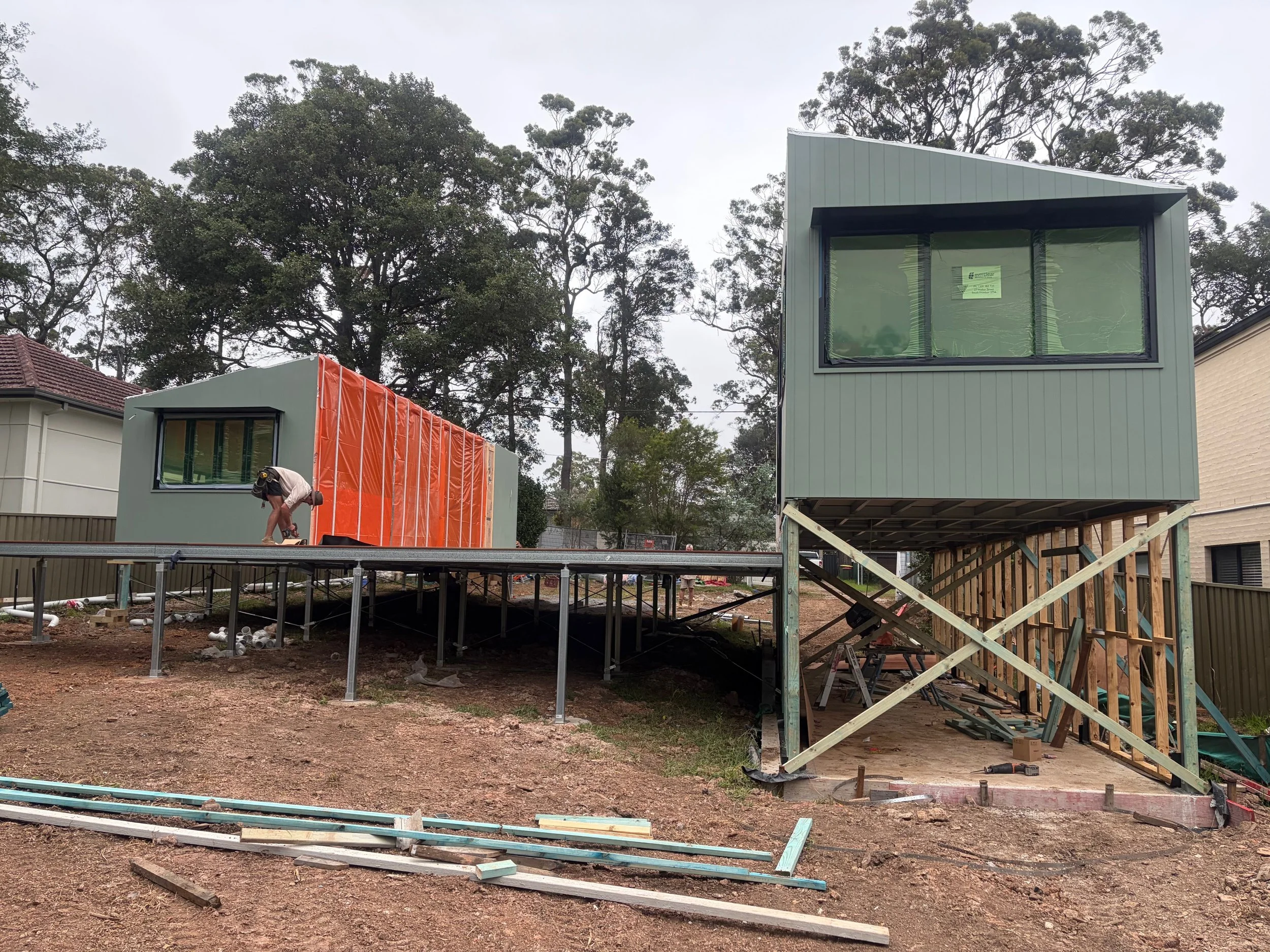
When physiotherapists Laura Stefani and Tom Hol decided to knock down and rebuild their family home in Heathcote in Sydney’s south, they wanted a fundamentally different approach to construction — one aligned with their values around sustainability, efficiency, and thoughtful design.
Their journey to a custom modular home with MODE Homes demonstrates both the potential of prefabricated construction for everyday Australian families and the critical role that new finance products — like CommBank’s groundbreaking prefab loan — are playing in making it accessible.
A Values-Driven Decision
The couple’s interest in modular construction was sparked at a TEDx conference highlighting the waste generated by traditional building — estimated at nearly 40 per cent of all locally produced waste. “The waste reduction set us off on this trajectory,” says Tom. “In a factory, if you’ve got trimmings from one house, you can use them on the next, rather than chucking them in a skip bin.”
Beyond waste, they were drawn to reduced transport emissions and the superior thermal performance of factory-built homes. “We wanted a relatively passive design with good insulation,” Tom explains. “With the modular builders we were looking at, double-glazed windows and solid insulation were standard.”
Finding the Right Builder
Using the prefabAUS website and other research, the couple narrowed their search to builders who could deliver an architecturally designed custom home within budget. When they met MODE Homes’ architect-director Matt, the connection was immediate. “I thought they’d be way outside our budget,” Tom recalls. “But Matt said that [our budget was in line with] the majority of houses he builds. Within an hour and a half, we’d basically done our design.”
The resulting home — around 170 to 180 square metres internally plus generous decking and a plunge pool — is a modest but well-resolved split-level design that responds to the sloping block. Bedrooms are treated as places to sleep, with the design prioritising open-plan living, transparency, and connection to the outdoors.
Smart Design, Efficient Delivery
MODE Homes uses a pragmatic hybrid approach that keeps costs down without compromising design. Standard modules are just 3.5 metres wide, so they travel on standard roads without police escorts or pilot vehicles. Transport costs for each module came in at around $2,000 to $2,500, compared to up to five times that for wider modules.
More complex elements like the open-plan living area are built on-site using panels that connect to the factory-built modules, delivering factory efficiencies where they matter most while enabling larger living spaces that would be impossible to transport.
The build demonstrated prefabrication’s speed advantages. Laura and Tom lived in their existing home for 11 weeks while the new house was constructed in the factory. Once the old home was demolished, MODE’s team completed footings in a week and craned the modules into position the following Thursday. “By the end of three weeks, they expect to have the roof and externals on,” says Tom.
Breaking the Finance Barrier
Perhaps the most significant barrier the couple faced wasn’t planning or design — it was finance. Their mortgage broker contacted around 39 lenders and came back with a blunt recommendation: choose a different builder. “He said we should just build the normal way, because we wouldn’t have any trouble securing finance,” Laura recalls.
The problem was that traditional construction loans are structured around on-site milestones — slab, frame, lock-up. With prefabricated construction, the bulk of work happens in a factory before anything is visible on site, and most lenders couldn’t accommodate that.
Then CommBank announced its dedicated prefab home loan in early 2025, allowing customers to access progress payments before the home is affixed to land — up to 60 per cent of the contract price, rising to 80 per cent for accredited manufacturers. For Laura and Tom, it was transformative. “Once we provided the Section 68 approval, they’ve been really quick with payments,” Laura says.
Worth Every Step
Laura and Tom are candid that the journey hasn’t been without frustration. New South Wales planning legislation still categorises modular homes under outdated caravan park regulations, which added months of delays and required their home to be set back two metres from side boundaries rather than the standard 900mm — a challenge the NSW Government is now actively working to resolve.
Yet even with these hurdles, the couple have no regrets. “We’d still do it again,” says Laura. “We know it will be worth it. We’ll have a home that connects with our values.”
Their story illustrates a pivotal moment for Australia’s housing sector. With finance products like CommBank’s prefab loan removing the biggest barrier to entry and governments modernising planning frameworks, custom prefabricated homes are becoming a genuinely viable option for families who want quality, sustainability, and affordability.